Posts

Talking New Zealand History

Late last year Vaughan Rapatahana conducted an interview with me for Scoop Review of Books.    Kia ora Vincent. T ē n ā koe m ō t ā u pukapuka. Ka nui te pai t ē nei mahi. VR:  Let’s start at the top. The Great War for New Zealand: Waikato 1800 -2000 is a massive book and a mighty indictment of the ways in which P ā keh ā grabbed the land off and of M ā ori; a systematic snatching that of course has had and continues to have serious ramifications for many M ā ori today. What are the positive flow-on effects stemming from this important book, that you are experiencing yourself? Vincent : The response to the book has been phenomenal right from the day we launched it back in October 2016. That was at the Waahi Pā poukai in Huntly. I handed over the first official copy to Kīngi Tuheitia and wandered around the back of the whare where a big crowd was gathering. I wondered what was happening. It turned out they were already queuing to get their own c...

Raupatu and Remembrance: The New Zealand Settlements Act

Image
When dates were being considered for the first Rā Maumahara commemorating the New Zealand Wars one suggestion that was floated was 3 December. It does not mark the anniversary of any particular battle or conflict. Instead, on this day in 1863 Governor George Grey signed into law the New Zealand Settlements Act, an innocuous-sounding piece of legislation that was to have devastating consequences for many Māori communities. The Settlements Act provided the primary legislative mechanism for raupatu – sweeping land confiscations that were supposedly intended to punish acts of ‘rebellion’ while also recouping the costs involving in fighting the wars. It declared that where ‘any Native Tribe or Section of a Tribe or any considerable number thereof’ had committed acts of ‘rebellion against Her Majesty’s authority’ since 1 January 1863 their lands could be declared subject to the Act and seized for the purposes of settlement. It was part of a package of measures passed by the all-Pākeh...

The New Zealand Wars and the School Curriculum

Image
By Joanna Kidman and Vincent O'Malley The New Zealand Wars (1845-72) had a decisive influence over the course of the nation’s history. Yet Pākehā have not always cared to remember them in anything approaching a robust manner, engaging at different times either in elaborate myth-making that painted the wars as chivalrous and noble or, when that was no longer tenable, actively choosing to ignore them altogether. More recently there are signs of a greater willingness to face up to the bitter and bloody realities of these conflicts. For many Māori, that is not before time. If a turning point in Pākehā remembrance could be identified, then perhaps it might be the petition organised by students from Ōtorohanga College that led to a national day of commemoration for the New Zealand Wars (Rā Maumahara). In 2014, students from the school, some as young as 15, visited nearby Ōrākau and Rangiaowhia. The group was led by kaumātua who were descendants of the survivors. At e...

Defining Conflicts? The New Zealand Wars

Image
In this Friends of the Turnbull Library event, Dr Vincent O’Malley , author of The Great War for New Zealand: Waikato 1800-2000 , will present an overview of the New Zealand Wars – a series of conflicts that profoundly shaped the course and direction of our nation’s history. He looks at the origins, causes and consequences of these conflicts and discusses how the wars have been remembered historically. Vincent has recently received a Friends of the Turnbull Library research grant to help him research his latest book project, a history of the New Zealand Wars aimed at the secondary school market. 5.30 pm, Thursday 22 November Ground Floor, National Library of New Zealand Corner of Aitken and Molesworth streets Thorndon, Wellington Webpage: https://natlib.govt.nz/events/defining-conflicts-the-new-zealand-wars-november-22-2018

The Waikato War and Auckland

Image
Last month I spoke at the Hauraki Gulf Marine Park seminar, held at Auckland Museum, on how the Waikato War helped transform Auckland and the wider Hauraki Gulf. Auckland, I suggested, is a city built on immense Māori contributions, even if this history is not widely known or understood today. Watch the video of my talk here.

Teaching New Zealand Wars History

Image
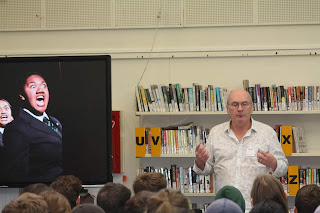
Efforts to ensure more young New Zealanders learn the history of the New Zealand Wars at school stepped up recently, with Stuff launching a campaign to support this kaupapa. As an editorial announcing the campaign noted: "Kiwi school kids can leave the education system knowing more about Tudor England than the New Zealand Wars.  This is a ridiculous situation and a sad indictment on our commitment to partnership under the Treaty." The series of stories included some inspirational examples of schools which had taken up the challenge , including one Hamilton primary school . The New Zealand Wars, I explained in one interview for the series, could best be understood as a clash between two competing visions of what the Treaty of Waitangi represented. I also spoke about this issue on TVNZ's Breakfast show. Over the past month or so I have been giving a series of talks in schools around the country on New Zealand Wars history, with more to come. I spoke about h...

Learning the Trick of Standing Upright Here

Image
Stuff recently ran a great series of stories as part of a special project called NZ Made/Nā Nīu Tīreni that included information about every modern Treaty of Waitangi settlement, maps of Māori land loss and explanations about how had this occurred. As John Hartevelt wrote in introducing the project : "New Zealand has not done well at grappling with its past. The unsettling truth about how this country was made is still not well understood. It has not been adequately taught in our schools. Our popular culture hasn't reflected it well enough. And our media has failed to tell it loudly and clearly. The Treaty of Waitangi, and its subsequent betrayals, is the heart of how New Zealand was made. We need to reckon with what happened in order to understand the Treaty settlements process that continues today." The theme of selective remembrance is one I returned to when invited to contribute an opinion piece as part of the series.           ...