Posts

Showing posts with the label Springboks

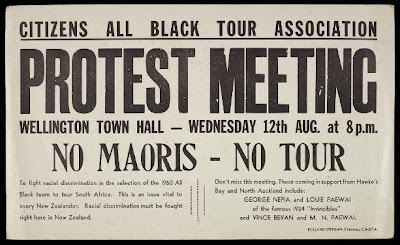
Political Football: Maori and the Springboks to 1965
Image
The rugby rivalry between New Zealand’s All Blacks and South Africa’s Springboks became part of each country’s sporting legend as a result of the Springbok tours of New Zealand in 1921, 1937 and 1956, and the All Black tours of South Africa in 1928 and 1949. The racism of white South Africans impacted on this sporting relationship, commencing with South African shock at having to play a Maori team in 1921. Their refusal to play the New Zealand Maori team on their 1937 tour prompted calls from Te Arawa and other iwi for a boycott. South Africa’s introduction of apartheid policies in 1948 resulted in the New Zealand Rugby Union agreeing to South African demands to exclude Maori players from All Black tours of South Africa. This led to huge protests against the 1960 All Black tour under the slogan ‘No Maoris, No Tour’. But despite a petition signed by 160,000 people, the government refused to intervene. South Africa offered to reclassify Maori players as ‘honorary whites’ for later tour...

Flying the Flag: The Maiki Hill Flagstaff, Kororareka

Image
Hone Heke was a man of his word. He had promised the governor he would put up a new flagstaff on Maiki Hill after felling the old one in July 1844. But that didn’t mean he wouldn’t chop it down again if necessary. And again, and again. Down she came. For the fourth time. It was March 1845. Heke Fells the Flagstaff at Kororareka, A-004-037, ATL Pandemonium ensued. A smoker dropped ash on some kegs of gunpowder, causing the whole magazine to blow. Heke had no truck with the settlers. His warriors even helped some of them flee town. But now it was too late to go back. It was a question of mana. Kororareka. The Hell-hole of the Pacific, they reckoned. Today it is refined, posh Russell. But the past lingers everywhere. It’s like a living museum. The British never did re-erect their flagstaff. Maori did it instead, in 1858. They had made their point. The flagstaff would be a token of reconciliation, not a symbol of sovereignty. They called it ‘Te Whakakotahitanga’, t...