Posts

Showing posts with the label Historians

2023 Talks and Events
Image
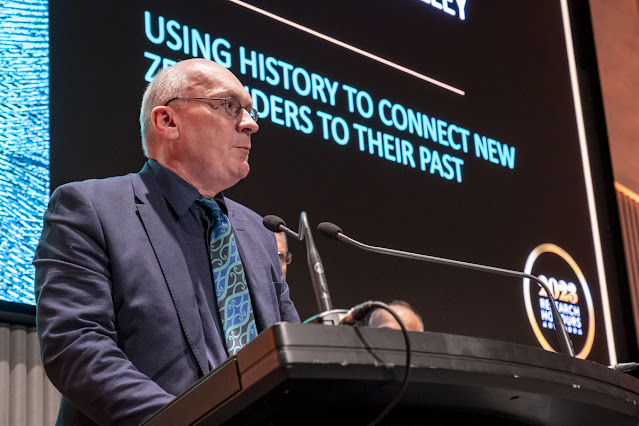
In the past twelve months I have taken part in a number of different talks and events alongside other participants.     Here, I provide links to those available to view online, organised chronologically.   Prime Minister's Awards for Literary Achievement, February 2023 An online panel discussion with the 2022 recipients of the Prime Ministers Awards for Literary Achievement:   • Fiction: Stephanie Johnson – a celebrated and popular author of twelve novels, as well as poetry, short stories, and writing for stage and television • Nonfiction: Vincent O’Malley - a distinguished author and historian of the New Zealand Wars and Te Tiriti o Waitangi • Poetry: James Norcliffe – an acclaimed poet and writer for children and young adults, as well as a prolific editor and poetry champion   All three writers will read and discuss their work with award winning writer and broadcaster, Nick Bollinger.     Scarred Nations Symposium, Auckland Museum, April 2023 Scarr...
New Zealand Wars, Land Wars, or Māori Wars?

Image
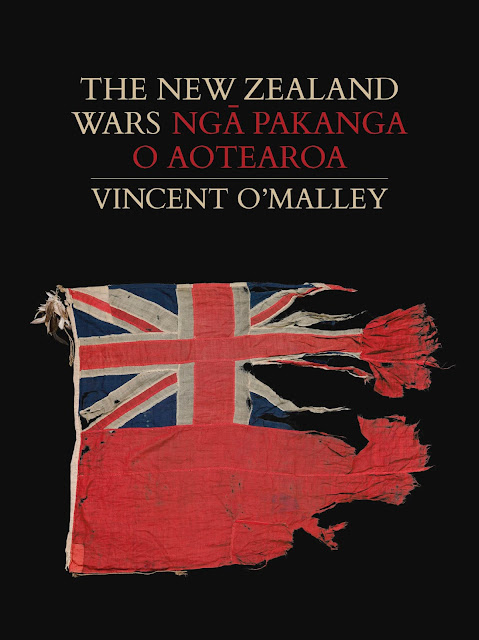
The following extract from The New Zealand Wars/Ngā Pakanga o Aotearoa first appeared in E-Tangata What historians and others have called the wars has changed over time. Why is this of interest? Do names really matter? Well, they do because they convey key messages about the nature of the wars, their causes and participants. For a long time, it was common to refer to this series of conflicts as “the Māori Wars”. That was consistent with the British tendency to name wars after their enemies; for instance, the Boer War, the Zulu War, or the Indian Mutiny. But there are some obvious problems with such a label. For a start, it tends to sheet home responsibility for the wars to Māori, rendering the other combatants invisible. In the 1960s, some historians tried to correct this by adopting the label “the Anglo–Māori Wars”. But this is also a problem, in that some Māori fought on the “Anglo” (that is, British or Crown) side. And given estimates that up to 40 per cent of ...

Book Review: Pickles and Coleborne (eds), "New Zealand's Empire"

Katie Pickles, Catharine Coleborne, eds. New Zealand's Empire. Studies in Imperialism Series. Manchester: Manchester University Press, 2015. 288 pp. $105.00 (cloth), ISBN 978-0-7190-9153-7. Reviewed by Vincent O'Malley (HistoryWorks) Published on H-Empire (July, 2016) Commissioned by Charles V. Reed Imperial Aotearoa   This collection of essays, published as part of Manchester University Press’s long-running and influential Studies in Imperialism series, sets out to challenge the notion of New Zealand as a periphery of empire. Exposing the country’s own imperial ambitions, both internal and external, the book examines New Zealand’s place within the British Empire. Despite its formal status as a colony until 1907 (and its belated adoption, in 1947, of the Statute of Westminster granting full independence), New Zealand was also a minor (sub-)imperial power in its own right, its administration of various Pacific islands and territories so inept that m...

New Zealand Parliamentary Debates Online

Image
Although important sources of New Zealand historical information such as the Appendices to the Journals of the House of Representatives , newspapers , British Parliamentary Papers and other items have been available online for some time, until recently there was at least one important omission, New Zealand Parliamentary Debates . I was pleasantly surprised to recently learn, via a Twitter announcement from Dr André Brett (who was instrumental in the move), that the NZPDs for 1854 to 1968 have recently been scanned and are now available to view through the Hathi Trust digital library . See the catalogue entry for them here . A fully searchable version on a New Zealand platform, such as the National Library website or DigitalNZ is the obvious next step (DigitalNZ link to the Hathi Trust holding of NZPDs on their own website). But for now this is a very welcome development in making important primary sources more accessible to a wider audience.

Waitangi Rua Rautau Lectures 2016

Image
I was recently one of a number of speakers at the Waitangi Rua Rautau Lectures for 2016, held at Victoria University of Wellington's Te Herenga Waka Marae. After the first address from Rotorua mayor Steve Chadwick discussing the council's recent partnership agreement with Te Arawa, the second part of proceedings focused in particular on the role of historians in the Waitangi Tribunal process. My own talk was a tribute to the late Professor Alan Ward, who passed away in December 2014. As I noted, I first met Alan in 1993, when I came to Wellington from Christchurch on a three-month contract to research claims for the Crown-Congress Joint Working Party, where Alan was the chief historian. Within six months of that, the CCJWP was defunct, but more than two decades later I'm still here doing more or less the same thing. And although there were times after that when we had less to do with one another, Alan and I worked closely together again on his final major publication, jo...

New Zealand Wars, Land Wars, Māori Wars?

Image
Last week a group of Otorohanga College students presented a petition to Parliament calling for a national day of memorial to remember the wars fought on New Zealand’s own shores. It is a cause I support and the petition, which attracted over 10,000 signatures (including mine), and its handover attracted significant media interest. But one thing that caught my eye was the description used in media reports for the wars themselves. Many referred to these as the ‘ Land Wars ’, the ‘ New Zealand Land Wars ’ or even the ‘ Māori Land Wars ’. There appeared to be little awareness on the part of journalists that what historians have called the wars has changed over time. Do labels really matter? Well, they do because they convey some key messages about the nature of the wars, their causes and participants. To begin with it was common to refer to this series of conflicts as ‘the Māori Wars’. That was consistent with the British tendency to name wars after their enemies, like the Boer War, the...

Book Review: Tony Ballantyne, "Entanglements of Empire: Missionaries, Māori, and the Question of the Body"

In August 1837, a group of Anglican missionaries belonging to the Church Missionary Society (CMS) assembled at Waimate, one of their stations in the Bay of Islands, in northern New Zealand. There the party proceeded to torch a cottage, destroying the property within it and even shooting dead a horse. A week of prayer and fasting followed. The unfortunate horse’s owner, William Yate, had been dismissed from the CMS months earlier, following allegations of an inappropriate relationship with one of the crew on board the Prince Regent during its journey from England to New Zealand a year earlier. That in turn had resulted in several Māori male youths coming forward to testify that Yate had engaged in sex acts with them. Yate was hardly the first or last missionary to fall from grace, even within New Zealand. Yet as Tony Ballantyne argues in his new work, a close reading of Yate’s case has often been framed in terms of questions of sexual identity rather than the broader co...

On Writing History, Colonization and Development in New Zealand between 1769 and 1900: The Seeds of Rangiatea

By   Ian Pool, Emeritus Professor, University of Waikato   Vincent O’Malley has generously made space available to me for a guest-blog in his series. I should mention, even before I start, that I owe a lot to Vincent’s patient responses to my questions and other forms of help in writing my book. Marching into the specialised territory of real historians is always a challenge for those of us who are on the fringes of the discipline.   In New Zealand this is particularly true, as Aotearoa has a significant corpus of powerful historical research – focused, technical monographs on many topics; elegantly written general narratives in the best humanities’ traditions;   and broader annales- type studies. In sum, I owe a large debt to historians. Above all, historians have carefully documented the 19 th century, for example , its prime and momentous events, the key actors and their actions, the constitutional trends, the interactions of Pākehā and Māori (albeit...