Posts

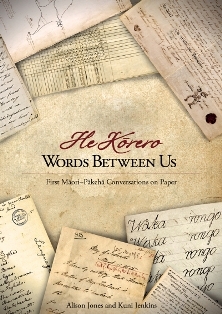
Book Review: Alison Jones and Kuni Jenkins, "Words Between Us — He Korero: First Maori-Pakeha Conversations on Paper", Wellington: Huia Publishers, 2011
Image
  Alison Jones and Kuni Jenkins, Words Between Us — He Korero: First Maori-Pakeha Conversations on Paper , Wellington: Huia Publishers, 2011 Words Between Us was published late in 2011, just as the final touches were being put to my own The Meeting Place: Maori and Pakeha Encounters, 1642-1840 . That was too late to even note the publication of this new work. It is only now, therefore, that I have had an opportunity to read the Jones and Jenkins book. I’m pleased I have done so. Some books can be a chore to read. This is not one of them. The story of early Maori engagement with writing is told with considerable skill. Examining several copybooks in which Maori boys learned to write at one of the missionary schools in the 1820s set the authors off on a journey to discover how Maori first encountered writing and what it might have been like ‘to take up a European technology that, by some obscure power, seemed to be able to speak in the language of the local people’ ...

The Sexual Politics of Pre-Treaty New Zealand: A Love Story from the North

Here's a story I like. On one level, it's a simple love story. But as I explain in The Meeting Place: Maori and Pakeha Encounters, 1642-1840 , the events described also provide a rich insight into the sexual politics of pre-Treaty New Zealand. Richard Cruise, a member of the crew that visited New Zealand on board HMS Dromedary in 1820, first told the story of two young lovers, one Maori, the other Pakeha, and the complex chain of events their desire to be together set off. Here is the story in his words: The ascendancy that the native women were capable, in some instances of obtaining over the mind of a European, was strongly exemplified, at this time, in the person of a very young man who held a situation of much respectability in the ship. Soon after our arrival at Wangarooa, he was employed with others in superintending the men employed in making the road; and during his residence on shore, he so strongly attached himself to the daughter of Towi, the chief of Rangehoo,...

The Great Kiwi OE Pioneered by Maori: Te Pehi Kupe's amazing Journey to England

Image
Maori were the original architects of the great Kiwi OE. That fact is easily forgotten in traditional narratives of early New Zealand history that emphasise European travel and discovery. But in the few decades before 1840 hundreds and perhaps even thousands of Maori had travelled outside Aotearoa — many to Sydney and elsewhere in Australia and others even further afield. England remained the ultimate travel destination for many Maori. The story of Hongi Hika’s famous 1820 encounter with King George IV is widely known. But how many people know the tale of how one chief from the Wellington region went to remarkable lengths to make the same journey? This is the story of Te Pehi Kupe and his amazing travels, as told in my recent book, The Meeting Place: Maori and Pakeha Encounters, 1642–1840 . It must have been one of those rare Wellington days. In February 1824 the trading vessel Urania found itself becalmed as it attempted to make its passage through Cook Strait. Three large waka...

Waikaremoana Lake and Lands — A Short History of the Ngati Ruapani Claim

Image
In 1840 the Ngati Ruapani people lay claim to an area of more than 250,000 acres around the shores of Lake Waikaremoana (much of it subject to overlapping or contested claims from other hapu and iwi). Today, with the exception of a few tiny reserves, they are a landless people. The process by which Ruapani lands were wrested from their ownership and control was a long and at times complex one. Yet one key theme dominates the history of land alienation in the region: the Crown’s acquisition of almost the entire land base of Waikaremoana Maori was achieved only through compulsion or coercion. Ngati Ruapani never willingly parted with any of their lands. Ownership of the lakebed of Waikaremoana itself was also bitterly contested between Maori and the Crown. Although the Crown lost that battle, it effectively won the war by ignoring Maori ownership of the lakebed for half a century, and then imposing a settlement that gave it perpetual access to the lake. But the battle for control of Lake...

Back to the Future?

Image
It’s been said that history is just another excuse for us to feel superior to our ancestors. We are so much smarter, more sensitive and certain of our place in the world than they ever were. Or at least we like to think so. But what if we could learn from those who went before us? That would be consistent with the old Maori saying about the past always being before us. From this perspective, history is less a linear story of boundless progress, than a more circular tale in which we sense we have somehow been here before. New Zealand, here in the early years of the 21st century, stands on the threshold of a world it last inhabited nearly two centuries ago. That might seem a surprising claim, given that we associate the early 1800s with conflict and chaos. And it is true that pre-Treaty Aotearoa could be a dangerous and volatile place. But what I argue in The Meeting Place: Maori and Pakeha Encounters, 1642-1840,   is that what mostly bound Maori and Pakeha in thos...

Te Wiki o Te Reo Maori/Maori Language Week and Te Reo Maori (Maori Language) Claim

Image
  For Te Wiki o Te Reo Maori, guest blogger Bruce Stirling backgrounds the history of the Te Reo claim and the long struggle for recognition of the Maori language: The annual focus on speaking Maori, Te Wiki o te Reo Maori (Maori Language Week), has rolled around again, from 23–29 July 2012.  Arohatia Te Reo, Te Wiki o Te Reo Maori 2012 It’s been an annual event since 1975, building on the inaugural Maori Language Day instituted by Maori in 1972, but it took a 1986 Waitangi Tribunal report to help secure official recognition of te reo Maori and the resources needed to preserve and nurture the language. Action on the Tribunal’s recommendations included the establishment, 25 years ago, of Te Taura Whiri i Te Reo Maori (the Maori Language Commission) to promote te reo Maori. By the 1970s, te reo Maori was widely seen as in danger of dying out after more than a century of being suppressed in schools, in the interests of assimilating Maori. The official oppo...

Maori Claims to Water - Older Than You Might Think

Image
Whenever Maori claims to the Waitangi Tribunal are brought to the public attention through the media it seems that, for many non-Maori, these are like bolts from the blue. The implication is that such claims are new, opportunistic and manufactured. That is invariably not the case. Nearly all such claims have deep historical roots. It is not my intention to outline here the abundant evidence of historical Maori claims to water. Instead, a single piece of evidence concerning historical Maori claims to the Waikato River is highlighted. Waikato River, 1859 (PA1-o-207-042, ATL) Firstly, let me briefly explain the context. In 1859 the government forced through the purchase of the Pekapeka block, at Waitara, in Taranaki, against the determined opposition of many owners, led by Wiremu Kingi Te Rangitake. A year later, Crown efforts to forcibly survey the block were met with peaceable opposition from members of Te Ati Awa about to be dispossessed of their lands. The government resp...